Earth Observatory Home Skip the Navigation and go straight to the content. NASA Earth Observatory Home Data and Images Features News Reference Missions Experiments Search
NASA's Earth Observatory
Earth Observatory Navigation Bar
Natural Hazards
  Natural Hazards
Gray, rectangular map of the world with various green icons on it. Caption explains image.
The icons on the above map show the locations of natural hazards observed by NASA satellites. Choose one to see the latest image associated with that natural hazard event, or select one of the sections from our topic list to learn more about these extreme events.Tropical Storm Fay - August 19, 2008Beijing Implements New Pollution Controls - August 19, 2008Typhoon Nuri - August 19, 2008Phytoplankton Bloom in the Barents Sea - August 19, 2008Bushfires in Northern Territory, Australia - August 19, 2008Aleutian Islands' Kasatochi Volcano Erupts - August 15, 2008Dust Storm over the Persian Gulf - August 15, 2008Fires in California - August 15, 2008Tropical Storm Kammuri - August 13, 2008

Earth scientists around the world use NASA satellite imagery to better understand the causes and effects of natural hazards. The goal in sharing these images is to help people visualize where and when natural hazards occur, and to help mitigate their effects. All images in this section are freely available to the public for re-use or re-publication (please use credits as indicated for each image). More images can be found in our archive of older events. Check out our related links.

This Week's Events

* Severe Storms: Tropical Storm Fay
Tropical Storm Fay became the sixth named storm system of the 2008 Atlantic hurricane season after forming over the Dominican Republic on August 15. 3 Images, Updated: August 19, 2008
* Dust & Smoke: Beijing Implements New Pollution Controls
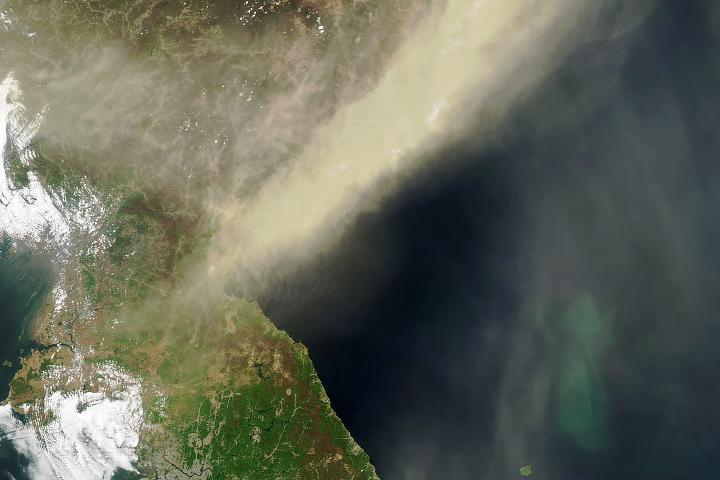
As Beijing prepared to host the Olympics August 8-24, 2008, and the Paralympics September 6-17, 2008, authorities implemented new procedures to reduce pollution. 3 Images, Updated: August 19, 2008
* Severe Storms: Typhoon Nuri
Typhoon Nuri first formed in the Western Pacific Ocean, east of the Philippines. As it traveled westward, the storm system reached typhoon status on August 18, 2008. 1 Image, Posted: August 19, 2008
* Unique Imagery: Phytoplankton Bloom in the Barents Sea
The waters of the Barents Sea off the northeast coast of Norway were bright with a bloom of phytoplankton on August 12, 2008. 1 Image, Posted: August 19, 2008
* Fires: Bushfires in Northern Territory, Australia
Numerous large bushfires were burning in the tropical savannas of Arnhem Land, in Northern Territory, Australia, in mid-August 2008. 1 Image, Posted: August 19, 2008
* Volcanoes: Aleutian Islands' Kasatochi Volcano Erupts
After earthquakes and other seismic activity starting on August 7, 2008, Kasatochi Volcano began erupting large plumes of ash and gases in subsequent days. Over the following week, the plume of sulfur dioxide spread across Canada and the Northeast United States. 4 Images, Updated: August 15, 2008
* Dust & Smoke: Dust Storm over the Persian Gulf
A dust storm blew over the Persian Gulf in mid-August 2008. The dust likely arose from the Tigris and Euphrates floodplain in Iraq. 1 Image, Posted: August 15, 2008
* Fires: Fires in California
"Dry" thunderstorms triggered hundreds of fires in California on the first day of summer 2008. In Northern California, fires continued to burn in August. 27 Images, Updated: August 15, 2008
* Severe Storms: Tropical Storm Kammuri
Tropical Storm Kammuri formed in the South China Sea in the first week of August 2008 and drenched Guangdong Province, including the city of Hong Kong, on August 6. 3 Images, Updated: August 13, 2008

Archive | Related Links | Section FAQ | Recommend this Page

  Crops and Drought Section

Dust and Smoke Section

Fires Section

Floods Section

Severe Storms Section

Volcanoes Section

Unique Imagery Section

   
Subscribe to Natural Hazards
About the Earth Observatory & Natural Hazards
Contact Us
Privacy Policy and Important Notices
Responsible NASA Official: Lorraine A. Remer
Webmaster: Goran Halusa
We're a part of the Science Mission Directorate